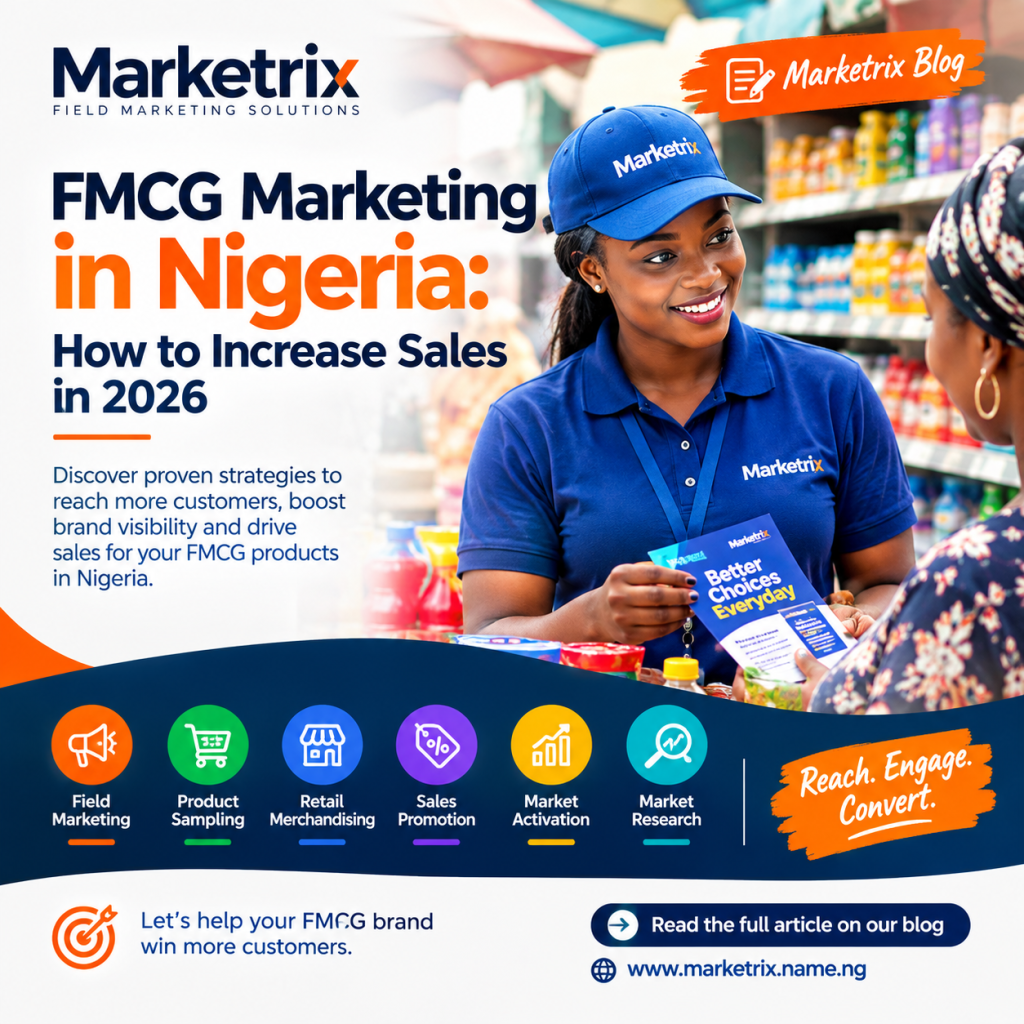
Nigeria’s FMCG market is changing quickly. Consumers are becoming more careful about what they buy, where they buy it and how much they spend. At the same time, brands are looking for better ways to increase product visibility, reach new customers and convert awareness into actual sales.
Recent FMCG data shows that Nigeria is entering a new phase of consumer growth. In Q1 2026, FMCG unit growth increased by more than 8%, while value growth remained below 1%. This suggests that consumers are buying more products and shopping more frequently as price pressures begin to ease.
For FMCG brands, this creates an important opportunity: the brands that can reach consumers at the right place, with the right message and at the right time can gain a stronger share of the market.
This is where effective FMCG marketing in Nigeria becomes important.
What Is FMCG Marketing?
FMCG marketing refers to the strategies businesses use to promote fast-moving consumer goods such as food, beverages, personal care products, household products, toiletries, packaged water, detergents and other everyday consumer products.
Because these products are purchased frequently, FMCG brands need continuous visibility.
Consumers may see a product on social media in the morning, notice it in a shop later in the day and eventually buy it when they encounter a promoter, product display or special offer.
That is why successful FMCG marketing goes beyond advertising.
It involves field marketing, product sampling, retail visibility, merchandising, sales promotions, market activation, customer acquisition and consumer research.
Why FMCG Marketing Is Important in Nigeria in 2026
The Nigerian consumer market remains highly competitive.
A customer walking into a supermarket, neighbourhood shop or open market can have dozens of products competing for attention.
Simply having a good product is no longer enough.
Brands need to make sure consumers:
- Know the product
- Understand what it does
- Trust the brand
- Can easily find the product
- Have a reason to choose it
- Remember the product when it is time to buy
This is particularly important because informal retail continues to play a major role in African consumer markets, while product quality, authenticity and value are increasingly important to consumers.
7 Effective FMCG Marketing Strategies for Nigerian Brands
1. Use Field Marketing to Reach Consumers Directly
Field marketing allows brands to take their products directly to consumers instead of waiting for customers to discover them.
Field marketing teams can operate in:
- Open markets
- Shopping areas
- Neighbourhoods
- Retail stores
- Supermarkets
- Universities
- Transport locations
- Events
- Residential communities
- Business districts
- High-traffic commercial areas
A trained field marketing team can introduce products, explain benefits, answer questions, distribute samples and collect customer feedback.
This creates a direct connection between the brand and the consumer.
For FMCG brands launching a new product or entering a new market, field marketing can be particularly useful because it provides immediate interaction with potential customers.
2. Product Sampling Can Increase Product Trial
One of the biggest challenges for a new FMCG product is getting consumers to try it.
Product sampling solves part of this problem.
Instead of simply telling consumers that a product is good, brands allow them to experience it.
For example, a beverage company can offer consumers a sample at a busy shopping location. A food brand can conduct tasting activities. A personal care company can distribute trial-size products.
However, effective sampling should go beyond simply handing out free products.
The activation should encourage the consumer to:
- Try the product
- Understand its benefits
- Remember the brand
- Know where to buy it
- Take an action after the interaction
When sampling is combined with proper sales messaging and retail availability, it can become a powerful customer acquisition strategy.
3. Improve Retail Visibility and Merchandising
Consumers cannot buy products they cannot find.
Retail visibility is therefore one of the most important parts of FMCG marketing.
Brands should pay attention to:
- Product placement
- Shelf visibility
- Point-of-sale materials
- Branded displays
- Storefront visibility
- Product availability
- Merchandising standards
- Competitor activity
A strong merchandising team can visit retail outlets regularly to check whether products are properly displayed and available.
This is especially important for products competing for limited shelf space.
A customer may already know your brand but still buy a competitor’s product simply because the competitor is more visible or easier to find.
4. Run Market Activations Where Your Customers Actually Are
FMCG marketing should not always happen inside shopping malls or large events.
Brands should go where their target customers naturally spend time.
Depending on the product, this could include:
- Markets
- Bus stops
- Neighbourhoods
- Schools and campuses
- Residential estates
- Motor parks
- Shopping centres
- Community events
- Business districts
- Entertainment locations
Market activation gives brands the opportunity to create memorable experiences while reaching a large number of potential customers.
Research published in 2026 also found that experiential marketing can positively influence customer loyalty in Nigeria’s FMCG industry, particularly through emotional and sensory experiences.
This shows why consumers should not only see a brand but also have meaningful experiences with it.
5. Combine Sales Promotions With Field Execution
Discounts, giveaways, bundle offers and promotional incentives can encourage customers to make purchasing decisions.
But promotions work better when consumers are actively informed about them.
A brand can advertise a promotion online, but a field team can take the message directly to consumers and retailers.
For example:
“Buy two and get one free.”
That message becomes more powerful when a trained promoter explains the offer to a customer who is already considering the product.
Field teams can also help retailers understand promotional offers and encourage proper execution at store level.
6. Understand the Nigerian Consumer Through Market Research
FMCG brands need accurate information about their customers.
Market research can help answer questions such as:
- Who buys the product?
- Where do they normally shop?
- What influences their purchasing decisions?
- What competing products do they buy?
- What price are they comfortable with?
- Why do some customers reject the product?
- Which locations have the highest demand?
- What do retailers think about the product?
- What problems are consumers experiencing?
Field agents can collect this information through surveys, interviews, retail audits and customer conversations.
This information can then be used to improve marketing campaigns, product positioning, pricing and distribution.
7. Combine Digital Marketing With Physical Marketing
Digital marketing is important, but FMCG brands should not assume that digital advertising alone will drive sales.
Consumers still interact with products physically.
They see products on shelves. They visit shops. They attend events. They speak to sales representatives. They receive recommendations from friends and retailers.
This creates an opportunity for brands to connect digital and physical marketing.
For example:
A customer sees an FMCG product on Instagram.
Later, a field promoter introduces the same product at a shopping location.
The customer samples the product.
The promoter provides information about where to buy it.
The customer eventually purchases it.
This creates a connected customer journey.
The Importance of Informal Retail in Nigeria
One major mistake FMCG brands can make is focusing only on supermarkets and large retail chains.
Nigeria has a huge network of neighbourhood stores, kiosks, open markets, independent retailers and other informal retail channels.
These locations are often where consumers purchase everyday products.
Brands therefore need a strategy that covers both modern retail and informal retail.
A strong FMCG field marketing campaign should identify priority retail locations, understand consumer traffic and ensure that marketing activities are connected to product availability.
How FMCG Brands Can Measure Field Marketing Results
A campaign should not be measured only by the number of flyers distributed or people who saw a promoter.
Brands should track meaningful performance indicators such as:
- Number of locations covered
- Number of consumers reached
- Meaningful conversations
- Product samples distributed
- Product trials
- Leads generated
- Customer enquiries
- Retail outlets visited
- Retailers engaged
- Product availability
- Merchandising compliance
- Sales opportunities
- Customer feedback
- Registrations or sign-ups
- Campaign conversion rate
Good reporting allows a brand to understand which locations, messages and audiences are producing the strongest results.
Why Professional Field Marketing Matters
FMCG campaigns can look simple from the outside.
A brand may need promoters to visit shops, distribute samples or speak to consumers.
But successful execution requires planning.
The agency must recruit suitable field agents, train them, assign locations, monitor daily activities, collect evidence, manage logistics and report results.
Without proper supervision, field campaigns can quickly become difficult to measure.
Professional field marketing therefore helps brands move from simply “doing an activation” to running a structured customer acquisition campaign.
The Future of FMCG Marketing in Nigeria
The Nigerian FMCG industry is becoming increasingly competitive.
Consumers have more choices, brands are fighting for attention and purchasing behaviour continues to change.
At the same time, the growth in FMCG volumes seen in 2026 creates opportunities for brands that are prepared to meet consumers where they shop and make purchasing decisions.
The future of FMCG marketing in Nigeria will not belong to brands that rely on one channel alone.
The strongest brands will combine:
Field Marketing + Retail Visibility + Product Sampling + Market Activation + Sales Promotion + Consumer Research + Digital Marketing
The goal is simple: reach the right consumer, create a positive experience, make the product easy to find and give the customer a reason to buy.
How Marketrix Helps FMCG Brands Grow
Marketrix helps brands connect directly with consumers through physical marketing and field execution.
Our services include:
- Field Marketing & Customer Acquisition
- Brand Activation
- Product Sampling
- Merchandiser Recruitment & Management
- Sales Promotion
- Market Research
- Poster Distribution
- Roadshows
- Market Activations
- Sales Outsourcing
- Field Agent Recruitment and Deployment
For FMCG brands, Marketrix can help plan and execute campaigns across selected Nigerian markets, deploy trained field teams, engage consumers and retailers, generate leads and provide campaign reports.
Whether your brand is launching a new product, entering a new market, increasing retail visibility or looking for more customers, physical marketing can help turn awareness into real-world customer action.
Frequently Asked Questions About FMCG Marketing in Nigeria
What is FMCG marketing in Nigeria?
FMCG marketing in Nigeria involves promoting fast-moving consumer goods such as food, beverages, personal care products and household products through strategies such as field marketing, retail marketing, product sampling, merchandising, market activation, sales promotion and digital marketing.
What is the best marketing strategy for FMCG products?
There is no single strategy that works for every FMCG product. A combination of field marketing, product sampling, retail visibility, market activation, sales promotion and digital marketing can help brands reach consumers at different stages of the buying journey.
Why is field marketing important for FMCG brands?
Field marketing allows FMCG brands to interact directly with consumers and retailers. It can help increase product awareness, encourage product trials, collect customer feedback and create sales opportunities.
How can FMCG brands increase sales in Nigeria?
FMCG brands can increase sales by improving product availability, strengthening retail visibility, conducting product sampling, running market activations, using sales promotions, understanding consumers and deploying field marketing teams in high-potential locations.
What does an FMCG marketing agency do?
An FMCG marketing agency can plan and execute field campaigns, recruit and manage promoters, conduct product sampling, manage merchandising, carry out market research, execute activations and provide campaign reporting.
Is product sampling effective for FMCG brands?
Product sampling can be effective because it allows consumers to experience a product before making a purchase. Its effectiveness improves when sampling is combined with strong product messaging, retail availability and follow-up.
Final Thoughts
FMCG marketing in Nigeria is no longer simply about putting a product in front of consumers.
Brands need to understand where their customers are, what influences their decisions and how to create meaningful interactions with them.
In 2026, Nigerian consumers are becoming more deliberate about what they buy, while FMCG volumes are showing signs of renewed growth.
For brands ready to compete, this is an opportunity to invest in stronger field marketing, better retail visibility, effective product sampling and customer-focused market activation.
The brands that get closer to their customers are the brands that are more likely to win the market.
Marketrix – Connecting Brands to People, Streets to Markets.